Chapter I
When the Gaze Becomes a System
At what moment does the capacity to observe transform into a form of automatic power? How does the gaze lose its human face.
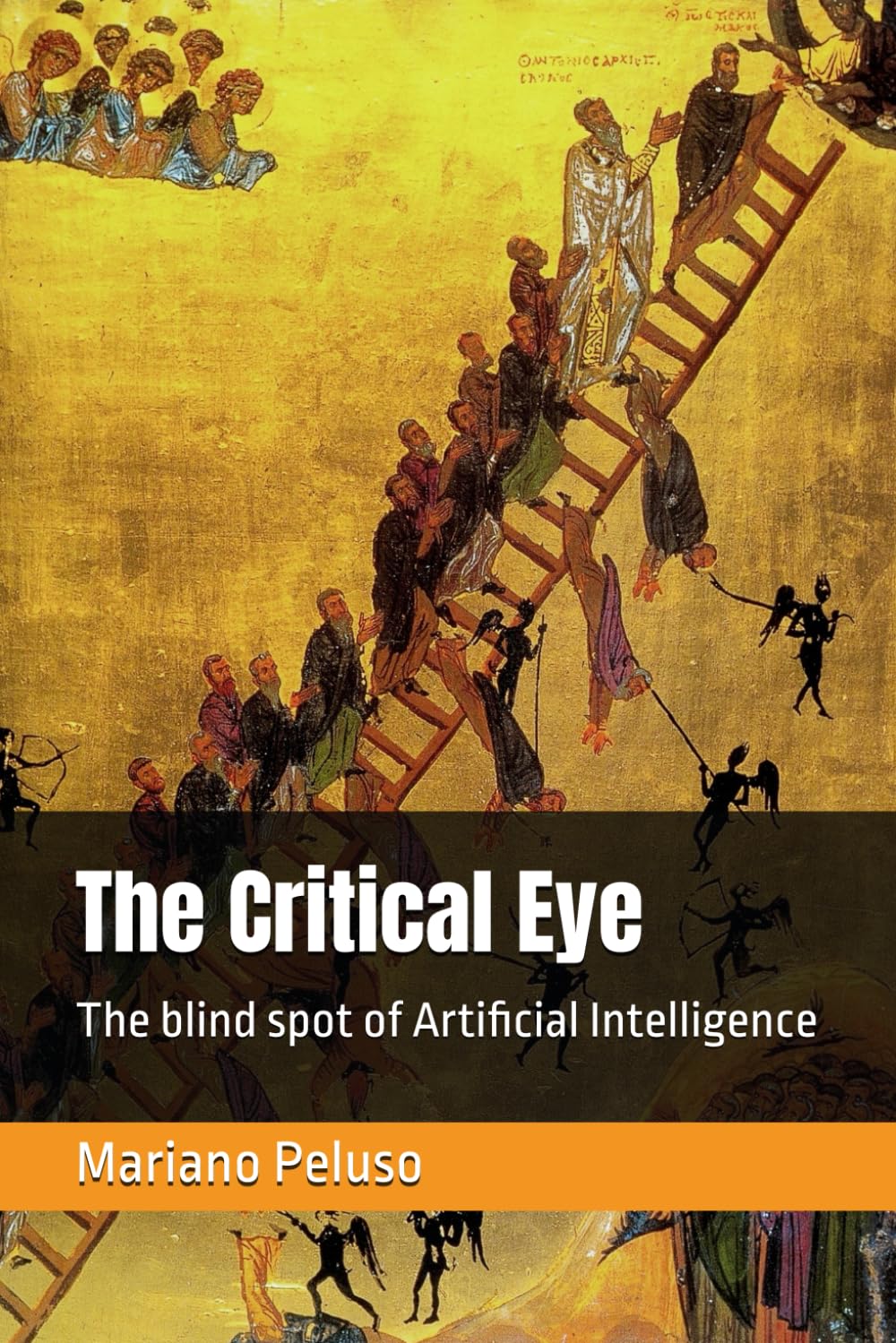
The blind spot of Artificial Intelligence
How to remain responsible in a world that functions without understanding us
We no longer live under a human gaze. We live inside systems that see, calculate, and predict. Artificial Intelligence is not merely a technology: it is a form of gaze that transforms the world into data and data into automated decisions.
This book explores the blind spot of intelligent systems—what every model must necessarily exclude in order to function, and what becomes invisible at the very moment prediction replaces choice.
Through a path that weaves together the genealogy of the gaze, analysis of predictive control, and reflection on responsibility, we discover how algorithmic power no longer operates through imposition, but through the normalization of what appears probable, efficient, and inevitable.
In a world where automated systems suggest, guide, and anticipate our choices, how much of individual sovereignty remains?
This book can be read as an indirect reflection on the contemporary society of control. By focusing on these systems, the discussion goes beyond technology: it highlights a deeper dynamic—the progressive outsourcing of judgment and responsibility.
These systems are not autonomous or threatening forces. They are devices that make visible tendencies already present in society: the desire to predict, simplify, and govern the complexity of reality. In this context, control is not imposed, but often accepted because it is perceived as efficient, neutral, or reassuring. Every suggestion, every algorithm promising objectivity, pushes us to relinquish small fragments of our judgment.
The risk is not an immediate loss of freedom, but a gradual reduction of critical insight. When decisions are delegated to systems perceived as neutral, we become accustomed to overlooking what truly guides them. The "blind spot" remains hidden, and uncovering it is a challenge for those who truly want to understand.
Within this framework, the reflection comes into tension with the modern idea of the sovereign individual. The sovereignty of the subject is not openly denied but progressively hollowed out. The individual remains formally free to choose, while the very criteria for choice are increasingly pre-defined, suggested, or automated. Are we truly free to decide, or do we accept a silent order that steers our choices without us noticing? The responsibility of systems and procedures becomes opaque, distributed across tools, rules, and decisions that appear neutral.
From this perspective, these systems act as amplifiers: they accelerate existing tendencies and reveal the ways in which power is exercised today, often invisibly and diffusely. Control manifests not through prohibition, but through the quiet guidance of choices, the normalization of preferences, and the promise of optimal solutions.
The reflection remains open and moves within the field of critical attention. Control can operate with or without automated systems. These systems are not its origin, but act as a catalyst that simplifies control processes.
Reading this book invites the question: how capable are we of truly observing and questioning the world around us without blindly relying on systems and procedures?
At what moment does the capacity to observe transform into a form of automatic power? How does the gaze lose its human face.
The shift from reactive control to predictive control. How probability becomes a norm when it guides action.
Every functioning model must exclude. When that blind spot becomes invisible, responsibility disappears.
The precise moment when a tool ceases to be consulted and begins to function as an inevitable horizon.
Making oneself invisible to systems is a defensive strategy, not transformative. True spaces of resistance lie elsewhere.
For the first time, the tools we use to decide produce solutions that exceed human capacity to understand.
How to reclaim responsibility without demanding total control. A possible posture between automation and human judgment.
A conceptual figure that makes criteria visible, exposes models, reveals what has been excluded to make decisions.
Awareness does not arise spontaneously. It is a cultural construction requiring time, space, and shared languages.
The cycle closes: systems generating other systems. How to remain present and responsible when control becomes cognitively fragile.
How the way we see determines how we govern in our time.
What every model must exclude to function becomes invisible and therefore undisputed.
How to maintain the imputability of decisions when the system functions without being understood.
The moment when probability replaces choice, and how this redefines power.
When systems function better than ever, yet become increasingly incomprehensible.
A collective practice for interrogating functioning without demonizing technology.